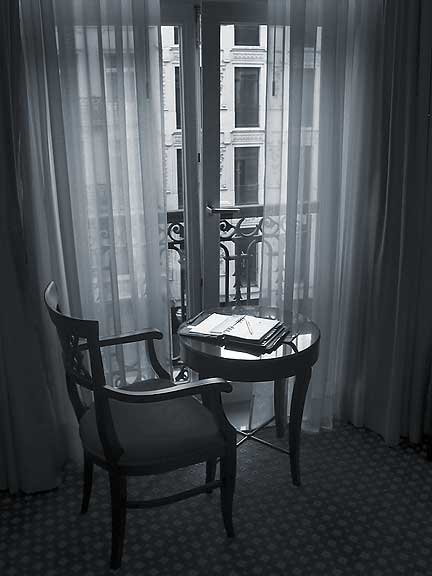
(from the Series: Insomnia: Hotel Noir)
…There has been a ton written about Business Strategy, most of which applies equally to a small business (us as artists) as the big corporations. I have found one gem on Business Strategy that has been been the greatest help and there are three basics parts to what is called the Hedge Hog Strategy. This is all detailed in the book Good To Great by Jim Collins. Basicly it means figuring out what you do best, and then doing it. (Duh!) But how many times have you liked a compnay’s product, then see them go into left field with other products & services and soon they are no longer be in business? It is very easy to get distracted, so these following three equal parts will help keep your hand on the tiller as you naviagte towards your island: What is your business/market, What do you do Best, and How do you measure your income?
What is your Business? This helps define who you are and as I mentioned in the Personal Strategy last week, this is very much intertwined. In most small business such as a Fine Arts, this is one in the same. But it helps to articulate this, are you a Fine Artist, a Fine Arts Photographer, or a perhaps a Photographer? Are you also an illustrator or freelance or teacher or a journalist? Do you have a public Gallery, and who do you show and represent? For our retail store, we were a gallery that represented local artist, sold custom framing and art supplies. Now I think in terms of my business as being a Fine Arts Photographer. At one time I was thinking of adding Black & White to what my market was, but realized that was tooo specific and I just might start working in Color. So you need to define your artistic business in relatively broad terms, but just not too broad.
What do you do best? Usually we can do a lot of things and this is where we can get distracted. As a photorapher, I can also photograph weddings, the soccer teams group photos, etc., and all very well. Is that my interest and what I do best, or better yet, is this what I want to be known for doing best? No.
Another personal example; when we started our consulting business, we we quickly asked by many medical companies to help with validating their processes. We were validating entire factories with a small team of engineers. But we were also asked to validate systems that we were not familiar with and even though the jobs were done correctly, it bothered me to put ourselves at a business risk of potentially botching a job. So using this question, what do I do best, it became very apparent: we do Sterile Medical Packaging best and essentially what we were known through out the U.S. for doing. So that is now our corporate business and we travel the world providing these very specific services for a small part of Corporate industry. Personally I can paint, I can’t make pottery, I can’t sculputre, but what I do very well and best of all of these is Photograph. And I want to concentrate on this as a Fine Artist, not a generalist.
How do you measure your income? And we do need some incoming cash to pay for all of those things we need to do to survive. Some have developed a minimalist lifestyle to make this work, but everyone still need some cash to live. For me as a Fine Arts Photographer, what I use to measure my cash flow is to measure print sales. If I see that my print sales are averaging 5 prints per (X), then I can anticipate what my future income may be and budget my spending. If the print sales start to slow down, then I have an indicator that something has changed and perhaps we don’t go out for dinner as planned later this month or I don’t buy the new lens. You may have book sales, grant applications, or instruction days/students. It just helps to have a barametor to know what is happening to your artistic career.
All of this probably sounds very basic, but the simplicity of seeing your artistic career in these three parts is very powerful. I have used this for the last six years with my consulting business with enourmous success. I am also using this for my artistic career to help us make decisions that don’t veer me off course.
Best regards, Doug
 Singular Images
Leave a comment