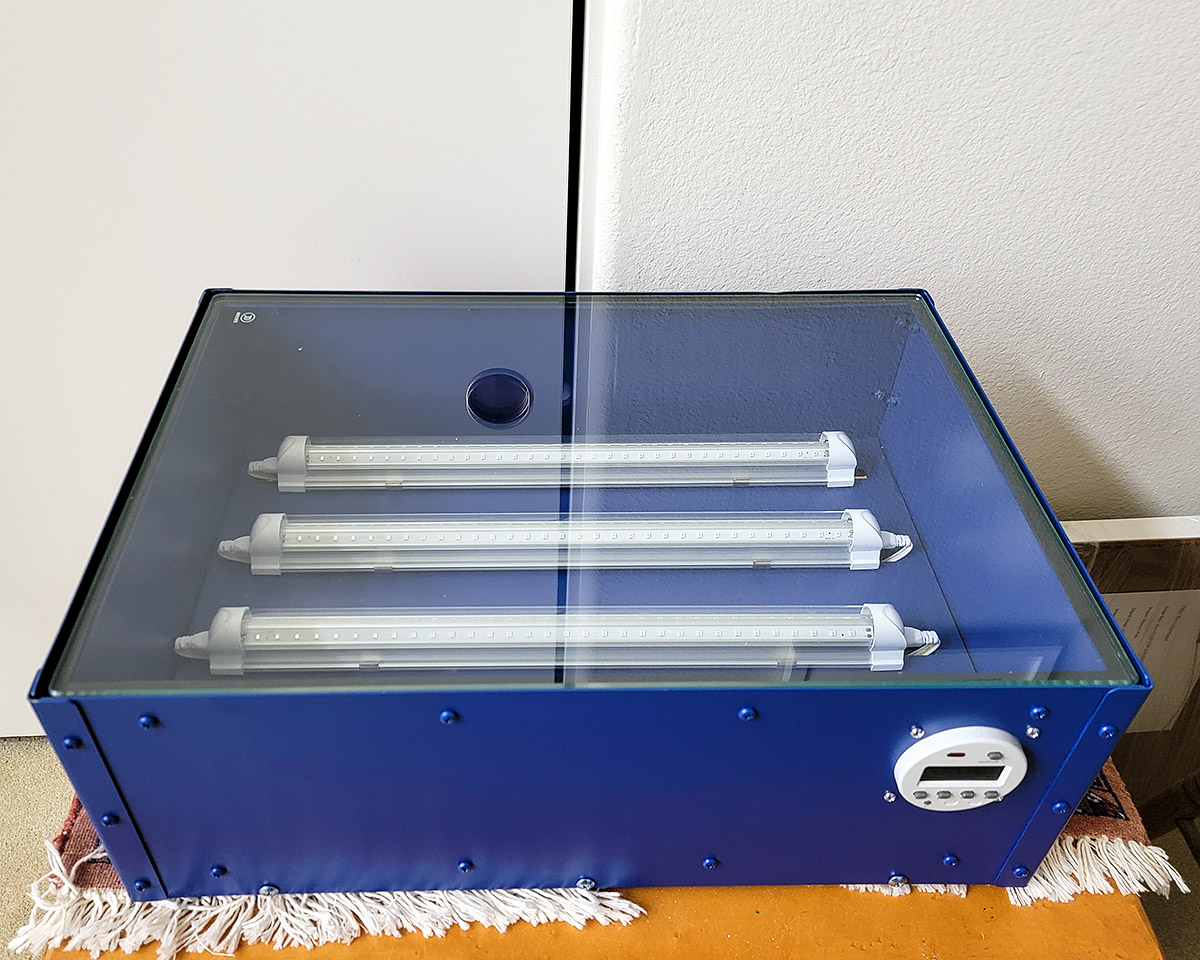
LED UV Lightbox, 2023 Douglas Stockdale –
For the past nine months I was committed to use solar printing for my cyanotypes…which was okay until it wasn’t. I have been sitting on my hands for almost all of May due to clouds (affectionally known as May-Gray here in Southern California), and already sensing the pending Southern California June-Gloom. When my last three solar cyanotype prints, due to the varying cloudy conditions, did not turn out as expected, I knew it was time for me to do something different. I have come to grips that the one really big variable in solar UV printing of cyanotypes is the sun as the UV light source.
My recently purchased UV meter did help a little, but not enough. The sun was either increasing or decreasing in UV intensity at the time of printing, thus the solar printing was slowly driving me crazy trying to figure out all of the variables. So I stated looking at UV lightbox equipment as an alternative.
At the moment, I am limited to cyanotype printing of 11 x 14″ sheets, so rather than purchase some really big and outrageously expensive UV lightbox, for a proof of principle I choose to downsize and keep it simple. Most of these LED UV lightboxes are designed for silkscreening and I realized I could save some money if I did not need a lid or a vacuum system as I planed to continue using my contact printing frame.
The small unit I purchased is meant for a 12 x 18″ silkscreen, which my 11 x 14″ contact printing frame just about covers the entire top of this lightbox, see below. My print area is also a bit smaller as the largest image I am printing is 9 x 12″ on the 11 x 14″ sheet. The lightbox has four rows of 15w LED light strands, which implies a 60w UV lighting. There was a minimal amount of assemble when it arrived, which did not require any tools. The unit is made in China with a timer that has Chinese symbols and an odd layout, but the one sheet of instructions was adequate to figure out how to make it work. I throw a black cloth that was provided over top of this unit and print frame during the UV exposures to ensure that there are no UV light leak problems.
As soon as it arrived, I had two things to quickly determine; what is the UV exposure time for my Dmax and then make some cyanotype prints to determine if the UV illumination was uniform without any banding or hot spots on the prints. I was able to accomplish all of this within the first three days. The Dmax UV exposure time for my combination of digital neg film printed with my Canon printer to make a cyanotype print was relatively short at ten minutes and the resulting prints look fine. This UV lightbox is a keeper.
I am also realizing as I reprint some of my earlier digital negatives how variable and essentially off-the-mark many of my earlier solar cyanotype prints are. I have already completed my first do-over of a digital negative to correct an earlier cyanotype image which I had thought that I had not calculated the solar exposure correctly. Now I know that it was not the solar printing but the digital negative that was causing the printing issue, which I would have not know without having a more consistent UV light source. So this investment is already providing immediate benefits.
I am already looking forward to a whole new series of cyanotype prints.
Make every day an Earth Day,
Doug

____

The Flow of Light Brushes the Shadow, an artist book from Singular Images Press, Fall 2022 release, $60.00 (CA sales tax for those residing in the USA) plus shipping expenses. Message me douglas.stockdale.artist@gmail.com or singularimagespress@gmail for shipping details and PayPal invoice.
Note: The Artist Special Edition (book + extra print) is Sold Out.
 Singular Images