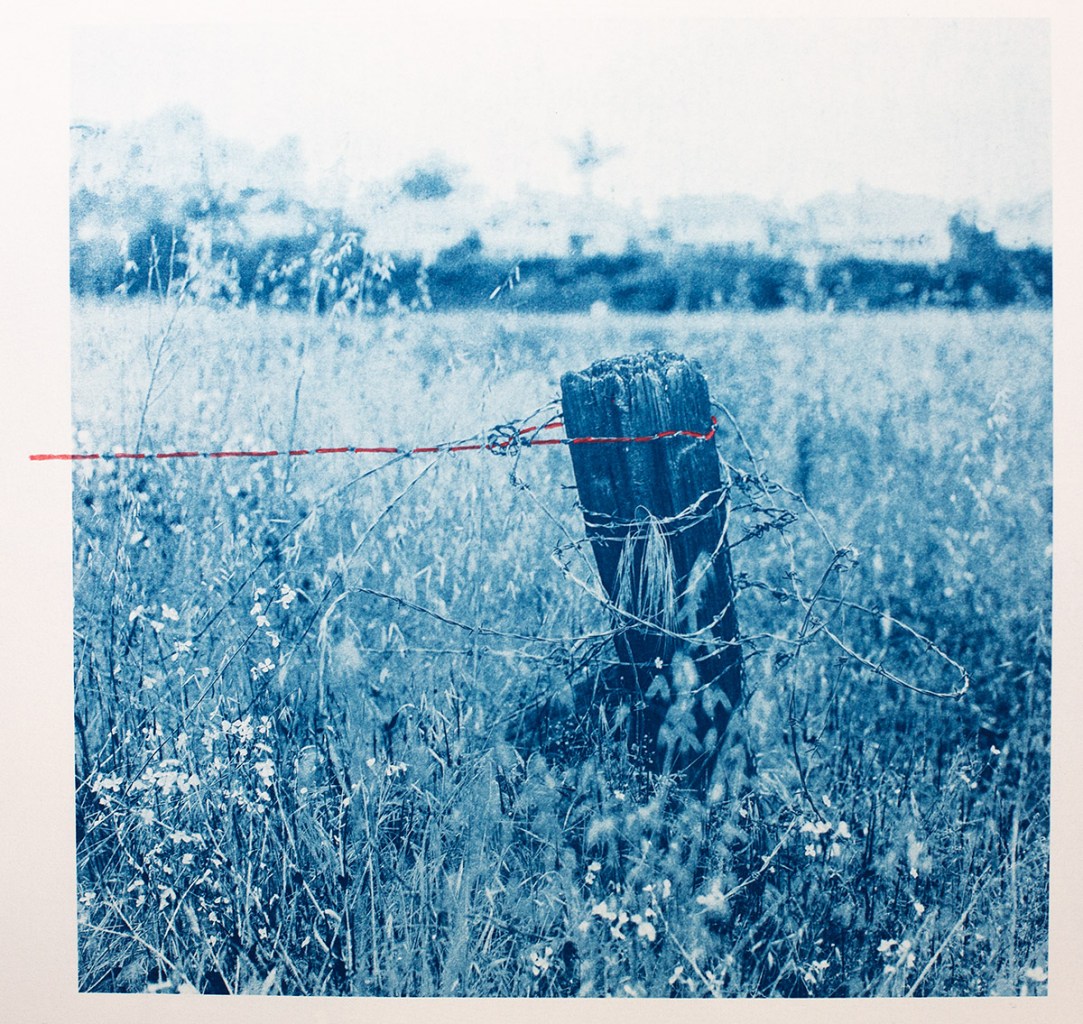
Untitled (Entanglement series) 2023 copyright Douglas Stockdale –
Good news, not so great news; Earlier this fall I found out I was a Critical Mass 2023 Finalist (wohooo!), while I subsequently found out that I was not selected as one of the Top 50 by the 200 curators who made the juried this (Okay, a collective ‘second place’ with 150 others).
The backstory is that while I was learning to print cyanotypes earlier this year, I had also acquired a 50mm Distagon (moderate wide angle) for my Hasselblad camera. While using the 50mm Distagon and expired film on the decommissioned WWII practice bombing range I live on, I started to consider what this area might ‘represent’, as a potential metaphor (Entanglement), rather than a straight photo-documentary that I had been working on up to this point. In conjunction I was printing the new work with the cyanotypes and I was connecting with the potential narrative. Long story short, I had printed 15 cyanotypes of this revised project when I realized that PhotoLucida’s Critical Mass was still taking submissions. Hmmmmm. I had another potential project to submit (The Last Iceberg) and I decided to quickly pull together an artists statement for Entanglement project, choose 10 of the 15 cyanotypes and make a submission, then continue working on the The Last Iceberg project. If the Entanglement project connected, then I would switch back to it for a while.
Bingo! When I was notified that I was a Critical Mass 2023 Finalist I resumed working on the Entanglements project again. I now have over 60 cyanotypes printed for this project.
When I found out that I was not in the Top-50, I was already having some second thoughts about this project regarding it’s overall cohesiveness. Then unexpectedly, I received back some comments for the curators who make the final cut, who resonated with the cyanotypes and they thought my artist statement was intriguing, but these two aspects were not working successfully together. So I have continued to re-examine my artistic intent in the context of my cyanotypes and I think I have figured out the weak link that’s in my artist statement. I had stated that my project was an investigation of ‘structural inequities’, which is really much broader than what I was photographing. My project was visually dealing with inequity issues of Housing and indirectly with Media, and not with issues of Gender, Health Care, Race and Education. Aha! When I tweaked my artist statement to focus on the structural inequities of Housing, I found my project now has more cohesion. Cool!
Second, realizing that the extensive amount of very old barbed wire that encircled this area could provide another visual metaphor that would help address another curators feedback. The Housing inequities that impacted Orange County, California in general as well as the entire United States was due to the redlining that occurred in the 1930’s by public bureaucrats, banks and real estate companies. By physically redlining a city map, whether in Orange County, San Diego County, Los Angeles County as well as elsewhere, designated areas that were ‘high financial risk’ due to lending to non-white families. This was the formalization of an informal process of housing discrimination and a structural inequity that impacts the nation today. Although this discrimination process was officially ended by the Supreme Court in 1967, individuals/companies found other means to accomplish the same goals, such as using computer algorithms to flag zip codes in which either mortgages are denied, and if granted, a higher mortgage rate and in conjunction with other stringent conditions. Similar to the past practices, the current discrimination is hidden from public sight, similar to the buried military ordnance in this decommissioned WWII bombing range.
Thus, a what-if I were to layer a red line on top of the old barbed wire images in my cyanotypes to represent the historical redlining? Thus the expired 120 film in conjunction with the historical cyanotype printing process could serve as physical and visual representations for past experiences. The unpredictability of the expired film and cyanotype printing process provides parallels to the inexactitude of memory and the unknown impact of past policies. The decay of the film and the historical cyanotype printing process corresponds to the decomposition of the former military site as well as deteriorating past discriminatory housing policies.
My first artist comp of this concept is below in which I had colored with Prismacolor pencils an inkjet print of one of the prime cyanotypes in consideration. For this version, I colored all of the barbed wire and since the actual barbed wire was rusted, I used a varies of Prismacolor pencils to try to make an accurate representation. Overnight, I realized that I was trying to be too realistic and that I needed to just use only a true ‘red line’. I then added another red line and since the redlining practice was extensive, then it made sense to carry my red line beyond the print’s boundary into the white margins. Cool!
After making another cyanotype print to hand-color, another idea was to just provide just one red line layer over the top most barbed wire in the image, which is my hand-colored cyanotype print, above, and not hand-color all of the barbed wire within the cyanotype. This allowed the remaining extensive barbed wire to be considered by the viewer, while allowing the cyanotype become a bit more elegant representation of my concept. So far, so good!
Untitled (scan 1765-4), 9 x 9″ cyanotype with hand-coloring (Prismacolor) on a sheet of 11 x 14″ sheet Revere archival cotton rag. Unique print.
Make every day an earth day
Doug
Below: Untitled (scan 1765-4) Inkjet print with hand-color

 Singular Images