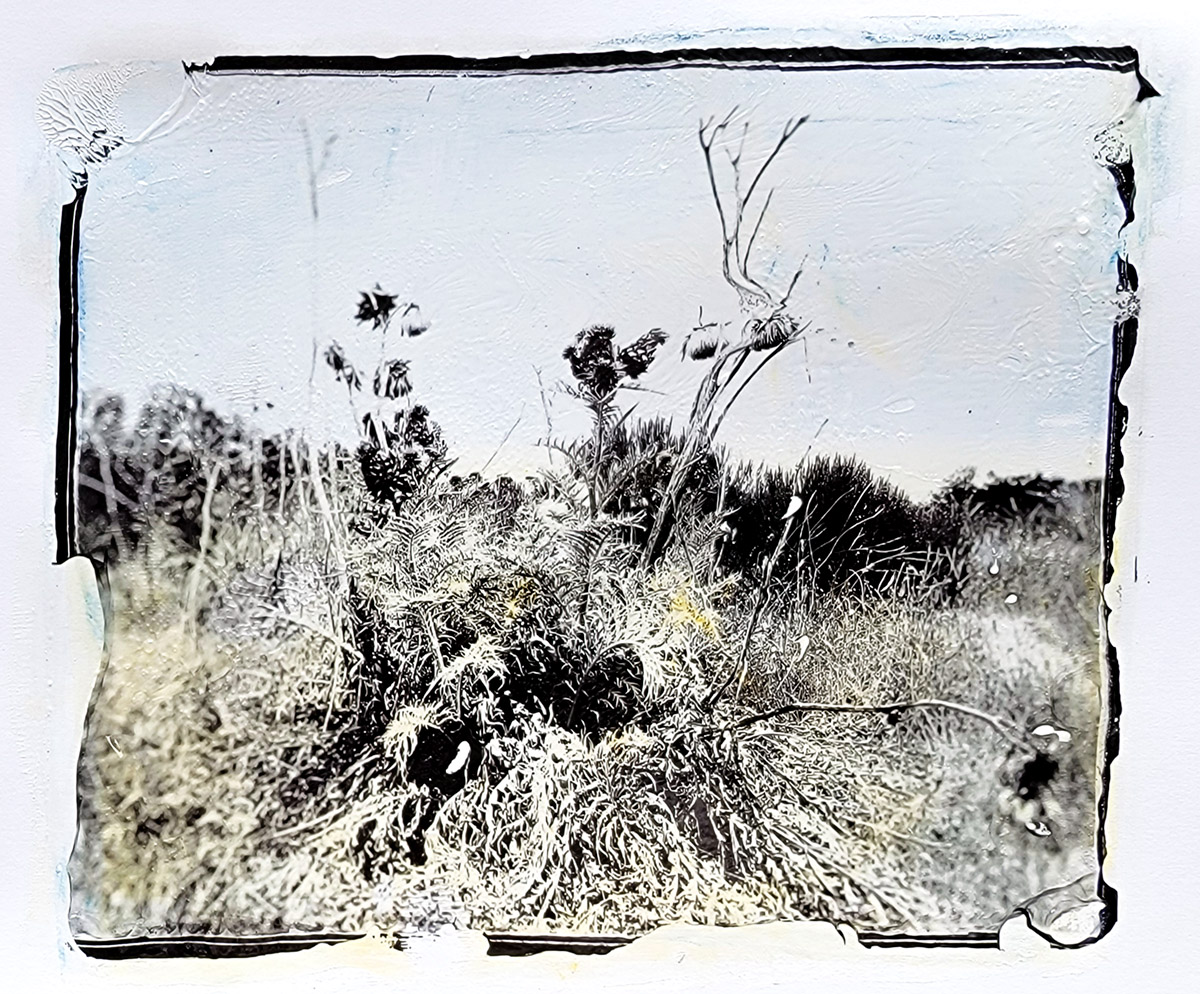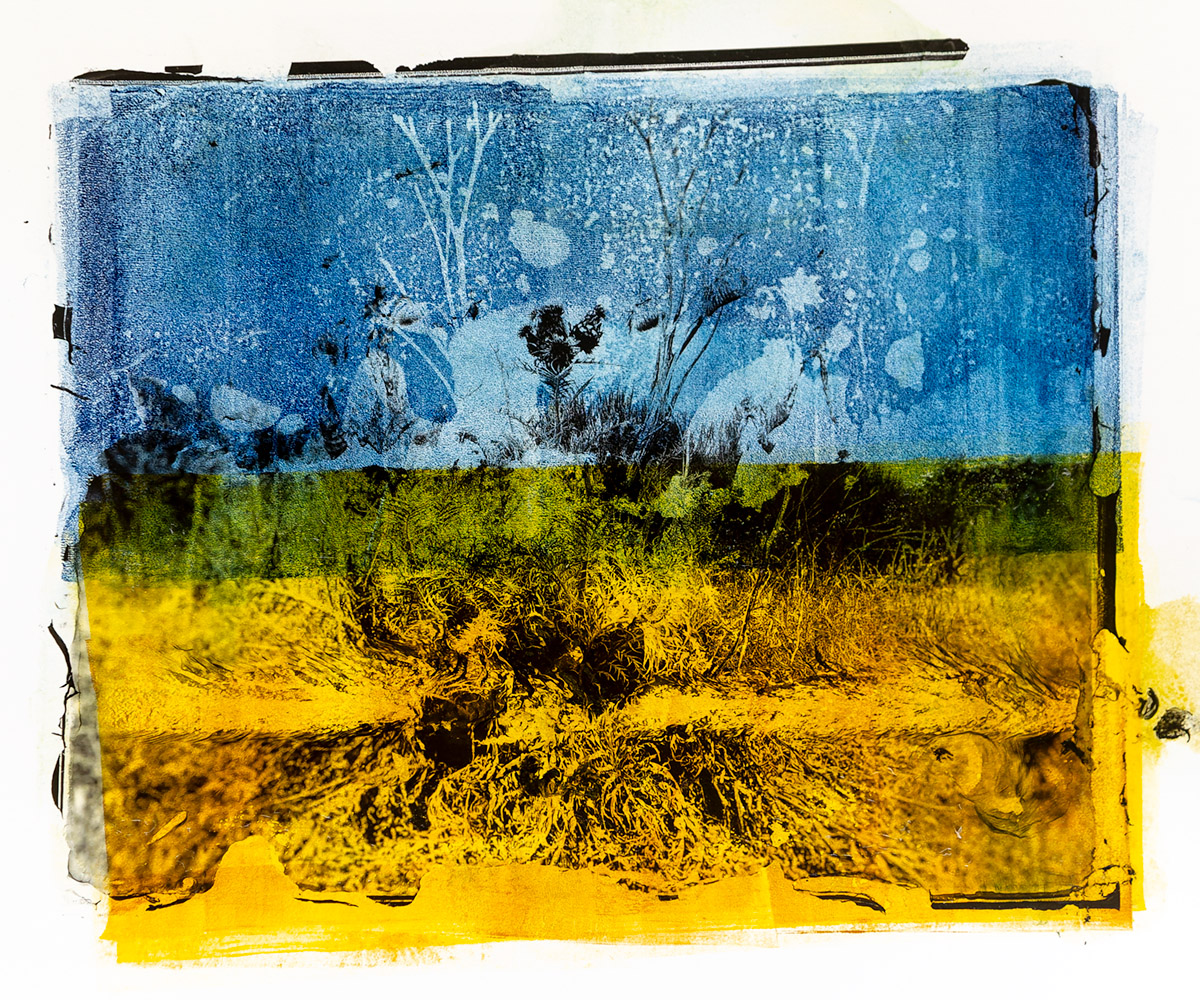
Artichoke Thistle, Spring Transition (monotype version 1), copyright 2026 Douglas Stockdale –
My intent with learning how to use the inkAID pigment ink transfer process was eventually to get to a point where I could combine this with my intaglio ink monotype process, as I had discussed here. Turns out that this was going to be a bit of a bumpy road and the start of a new learning curve.
Earlier for my monotypes I was printing my black and white image followed by the layers of intaglio ink, which in retrospect had a tendency to dull-down the black (dark) values. For this new pigment transfer process, I was going to follow the rules for commercial printing; print the various colors first and then print the black ink, which for me, should be the pigment ink transfer over the intaglio inks.
I use a printing frame and a reverse-image template to guide my intaglio ink printing process. While earlier having the black and white base image first, I could make some color adjustments ‘on-the-fly’ with the intaglio printing process. Now I was creating a color background which I might need to modify after the pigment ink transfer was completed.
So as you might guess the first couple of times, the pigment ink transfer went relatively badly, while I think in the realm of alternative photography where ‘happy’ accidents are cherished, things did not go as planned.
Lessons learned for my particular methodology with the first two transfers over the intaglio ink monotypes. First, I use water-based intaglio inks, which after some time, can still be ‘wetted’ and modified. Thus, even allowing at least 24 hours for the intaglio inks to dry, my inkAID transfer solution (remember, this solution is made with 91% IPA) reactivated the underlying printed intaglio ink. And this became a two-fold mess; the underlying intaglio ink started moving around (top print, such as the intaglio ink colors started running off the lower right border), and the pigment ink transfer also started moving around on the sheet (such as the wavy thistle in the Ghost print below).
When this happened the first time, I did not realize what was happening since this was my first attempt with this process. The second time, I realized what was occurring. Not that I could Google this as my methodology is a bit unique. Kinda of on my own in this adventure. LoL
Which is why I started to change my process; stay tuned, that’s coming next. (I have some subsequent prints that I need to copy and prep for my next article. Nevertheless, the goods news is that if I want to really mess up my resulting monotype (perhaps a bit of a Polaroid transfer appearance), I have some ‘creative’ ways to accomplish it.
Artichoke Thistle, Spring Transition (monotype version 1 above, Ghost monotype below); pigment ink over intaglio ink, 9″ x 7″ on 12″ x 9″ Bristol board, unique prints.
Cheers,
Doug