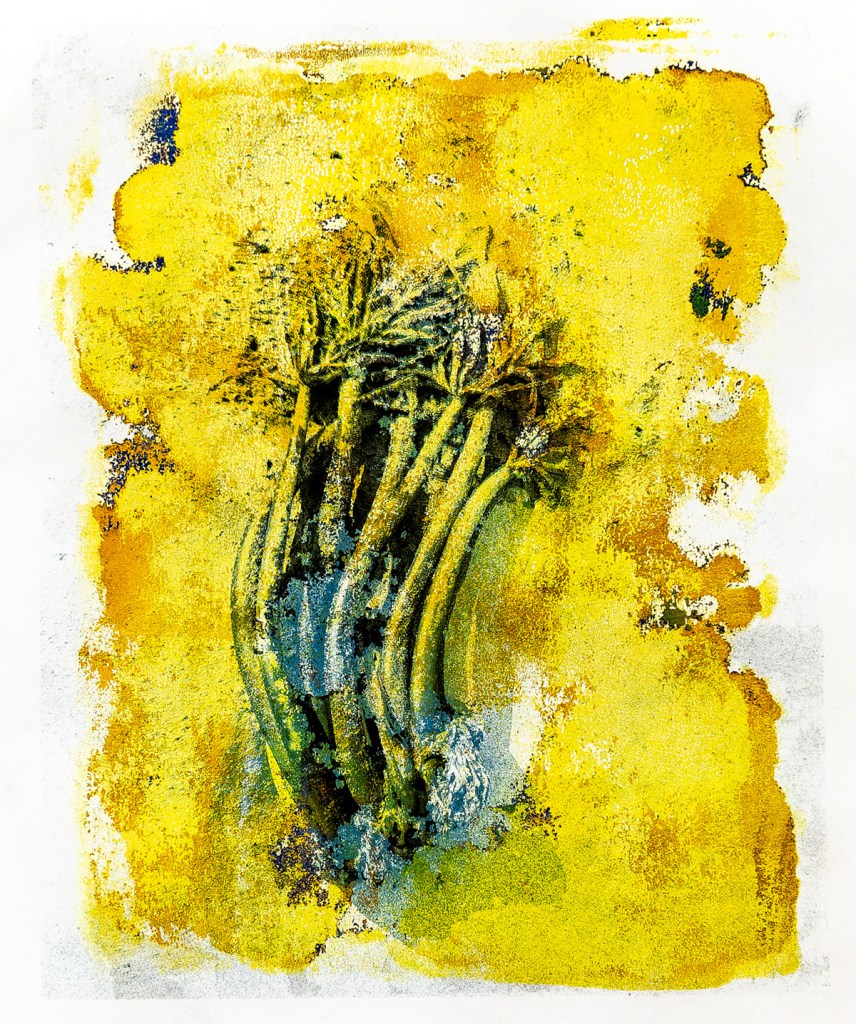
Sea Palm II (Bandon Beach, Oregon) Multi-media monotype copyright 2026 Douglas Stockdale –
Thinking about what I could use as potential implementation subjects of the pigment ink transfer process using inkAID film and solutions were the numerous early stage cyanotypes I had made in late 2024 and early 2025. At that time I was still using the pre-coated cyanotype papers from The Cyanotype Store in conjunction with solar printing the contact negatives that I had not optimized yet. These were pretty low contrast cyanotype prints without the darker values I obtained when I hand coated my paper and used a UV light box after developing an appropriated contrast curve for my negatives.
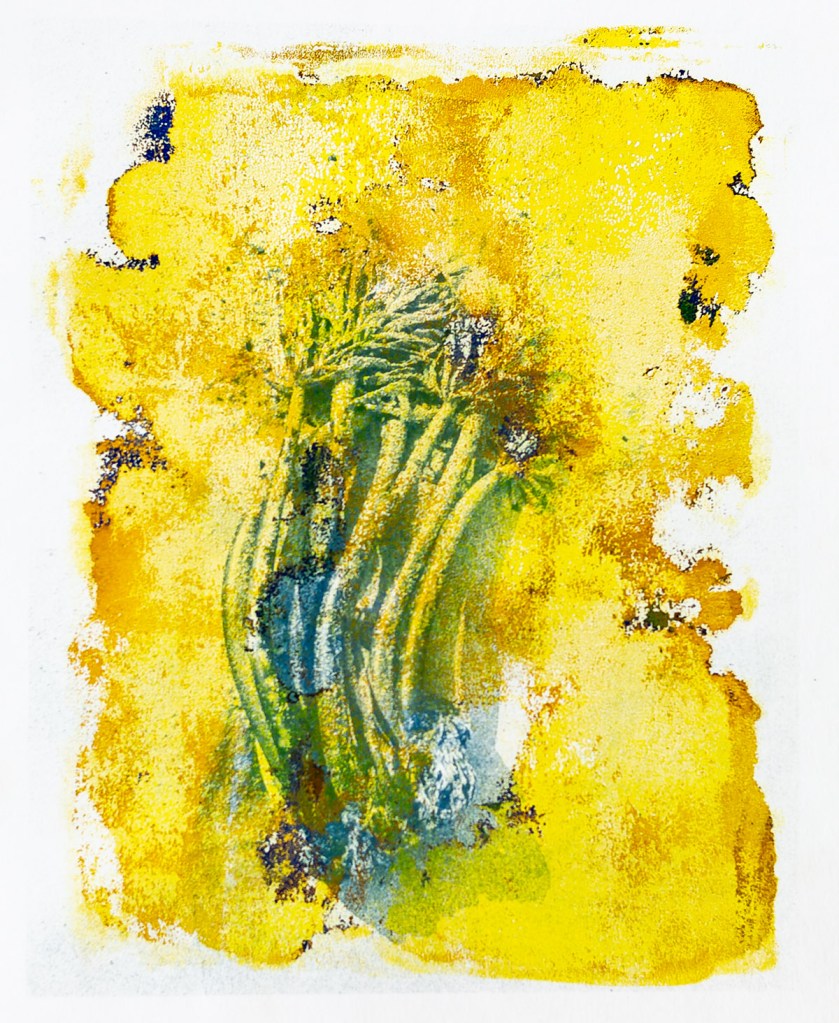
For Sea Palm II, I had used one of these earlier cyanotypes for my first set of experiments with acrylic paint and gel plate (relief) printing in 2024, see print image below. I had used a very transparent acrylic paint, while I realized after the gel printing session it was not ‘transparent’ enough for me. Dang. Interesting, but not what I had pre-visualized and what led me to later experiment with the really transparent intaglio inks. This also helped me realize that gel plate printing a cyanotype print with its pervasive Prussian Blue could create its own set of color challenges. So I set this and another gel plate acrylic paint print of Sea Palm II aside for later, although, I was thinking it might stand on its own.
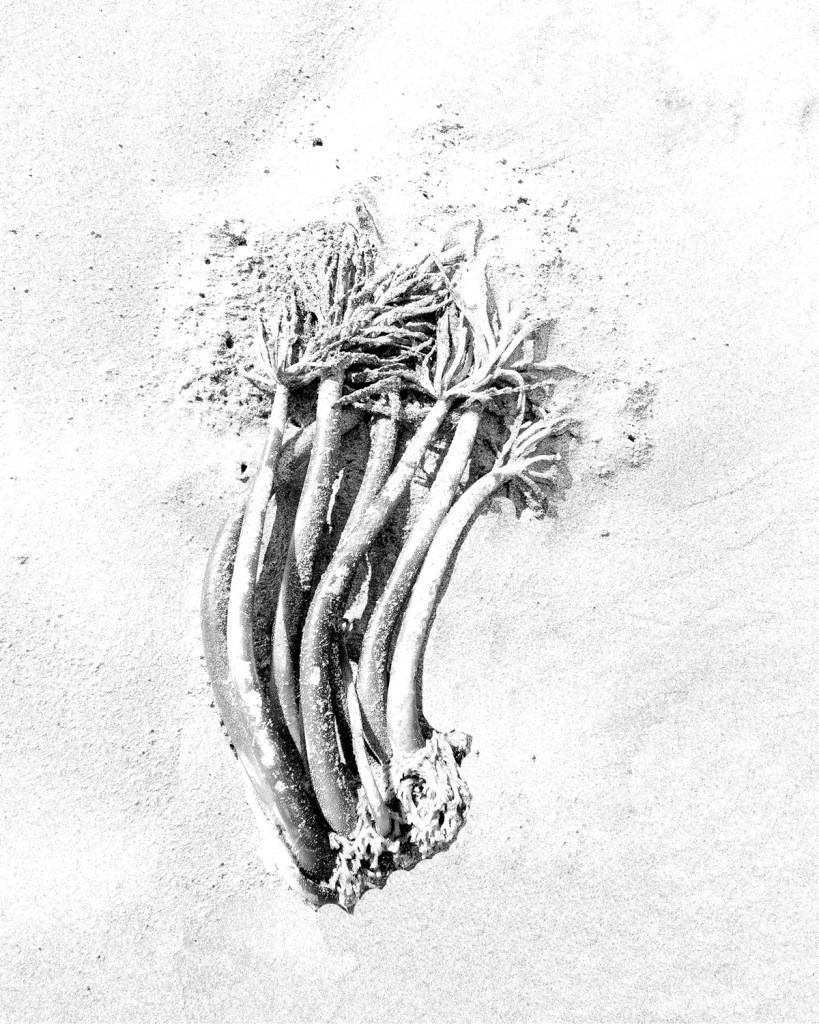
When recently looking through my pile of cyanotype prints, I realized that these two earlier monotypes might benefit from a wee-bit of black to restore the contrast and provide a little visual ‘punch’ with a pigment ink transfer. I wanted to reveal most of the acrylic yellow and orange, so I created a very high contrast image for the pigment ink transfer, below.
When I completed the pigment ink transfer this morning, it was initially one of those good-news/bad-news things. The transfer was completed on top of the acrylic paint sections, while not transferred on the open cyanotype areas of the print, thus the original cyanotype Prussian Blue was still evident. The print really looked great, but why the heck did the ink not transfer on the cyanotype area?
Early in my pigment ink transfer learning curve, I became aware of the issues of absorption and evaporation of the transfer solution to complete a good transfer. Because of how well the other areas transferred (good temperature and humidity this morning), I ruled out the evaporation issue. Maybe an absorption issue? Or that the cyanotype area of the print does not transfer well, if at all? I am suspecting that absorption could be the main issue as the pre-coated cyanotype paper is a uncoated cotton rag, specific for the water based cyanotype printing process and there was no residual transfer solution gloss that usually remains on a print where the transfer did not occur. A great clue that the transfer solution quickly absorbed into the rag paper.
I know how to fix both that as I had discussed earlier; fog coat a layer of acrylic medium on top of the cyanotype before I complete a pigment transfer. Nevertheless, this has provided another germ of idea of how to creatively use the pigment ink transfers with my cyanotype prints. Which means I need to first complete one more pigment ink transfer print test on a low contrast cyanotype print that is entirely a cyanotype print, without any monotype or other printing. So more about this later on this series of creative experiments…
My assessment of Sea Palm II with this pigment ink transfer on top of the cyanotype/monotype is that is’s very successful, and I am really enjoying this print much more than the earlier version. Mission accomplished!. The additional black increases the overall vibrancy of the print’s color and the additional contrast helps to further define the subject, a dislodged sea palm found on the Bandon Beach. Also a small amount of the original Prussian Blue of the initial cyanotype adds to the overall intriguing visual effect. Now a very solid ‘keeper’. win-win-win.
Sea Palm II (Bandon Beach, Oregon) Multi-media monotype (cyanotype, acrylic paint, pigment ink transfer)
Cheers,
Doug
___
___


Leave a comment